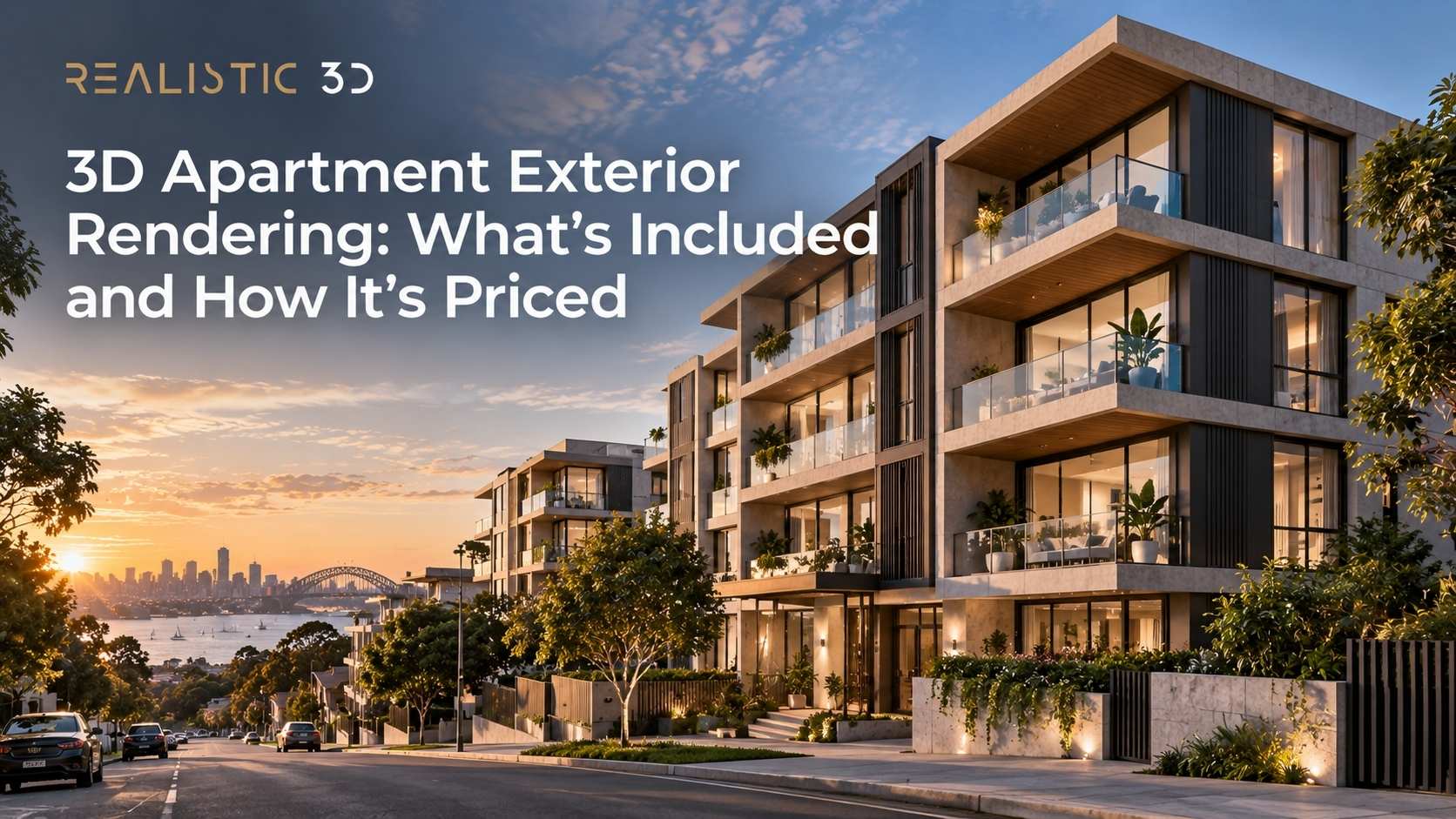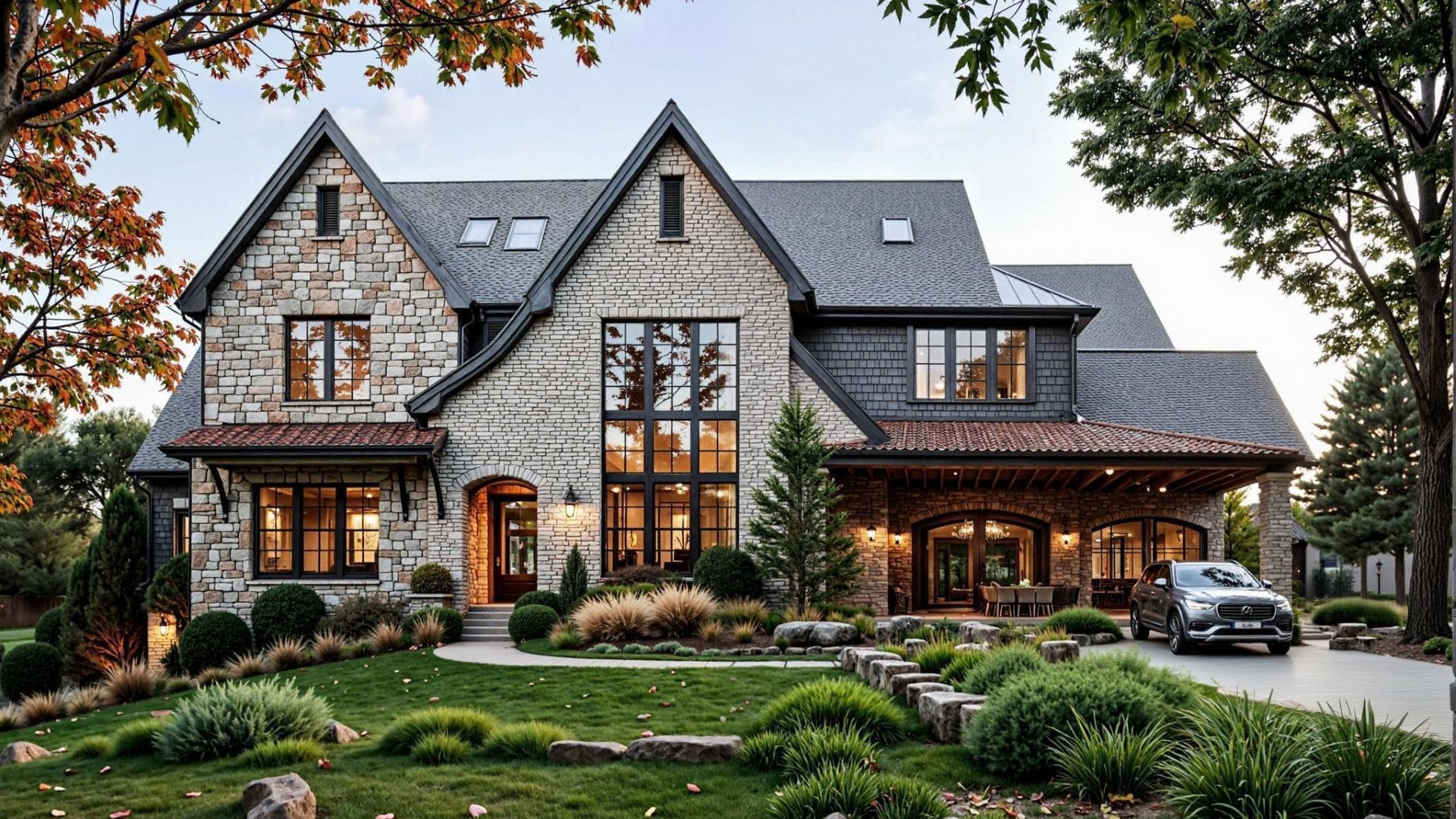
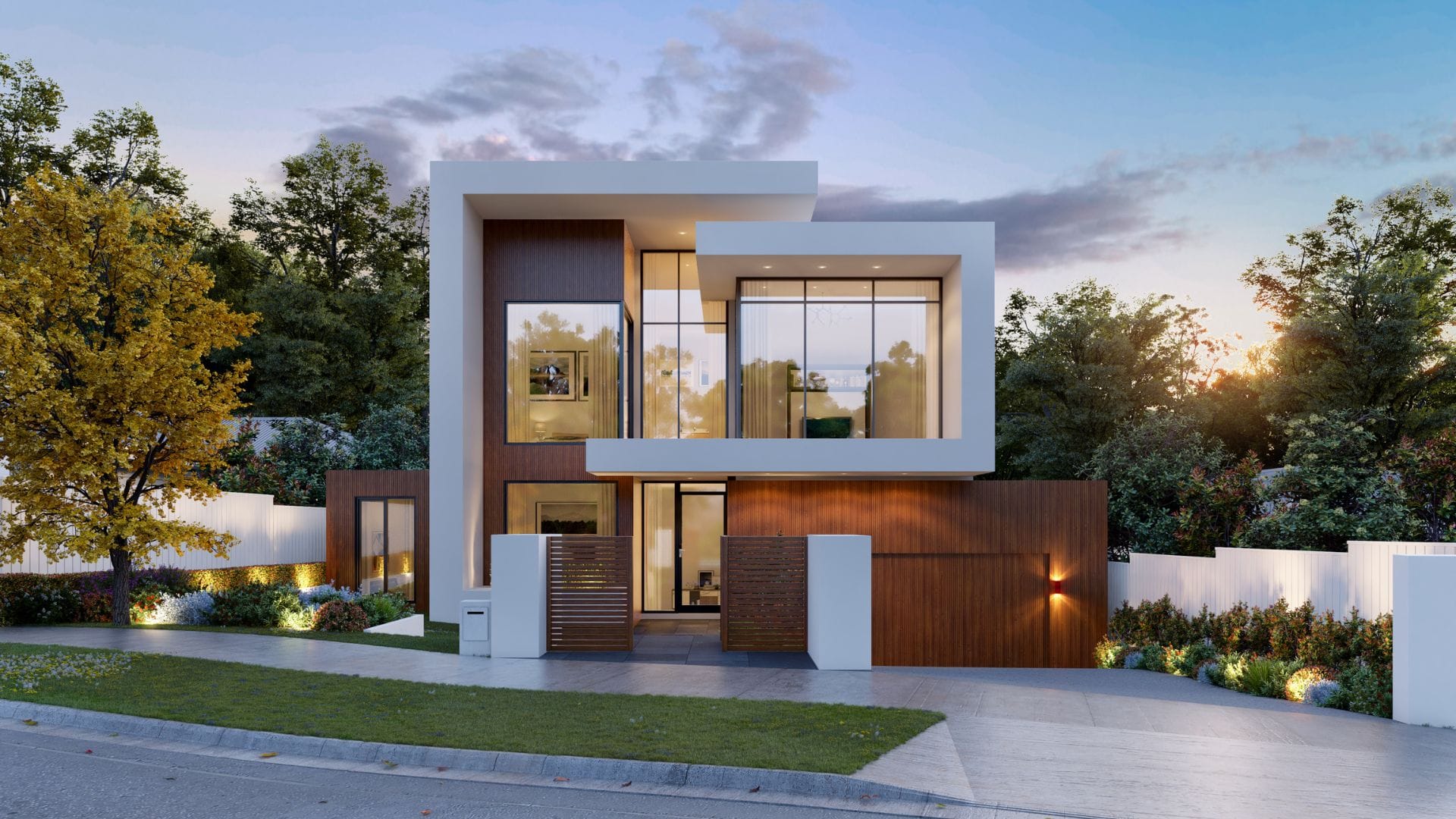
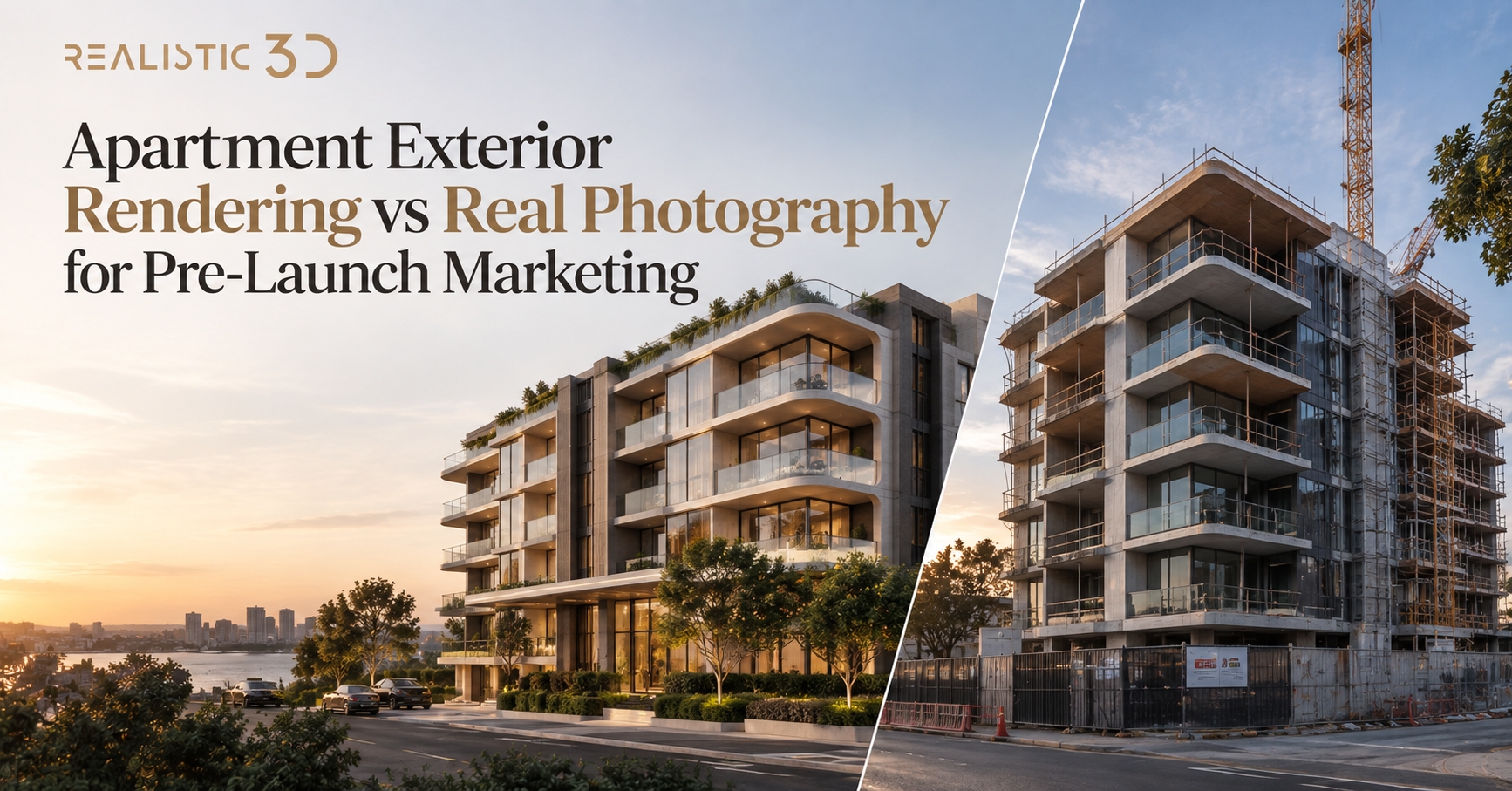
Apartment exterior rendering can show a proposed development before the facade, landscaping, podium, entrance, or surrounding public realm has been completed. For a pre-launch apartment campaign, this gives developers a way to communicate the future building when real photography cannot yet show the finished result.
Real photography serves a different purpose. It can show the actual site, existing neighbourhood, real outlook, surrounding amenities, construction progress, and completed work from the developer’s previous projects.
That makes the decision less binary than “rendering or photography.”
For most genuine pre-construction apartment campaigns, apartment exterior rendering carries the future building, while photography provides evidence of the real environment around it. As construction progresses, that balance should change.
The Core Difference: Future-State Evidence vs Present-State Evidence
The most useful way to compare rendering and photography is to ask what each medium can prove.
Exterior rendering describes an intended future condition. Photography records a real condition that existed when the photograph was taken.
That distinction affects almost every pre-launch marketing decision.
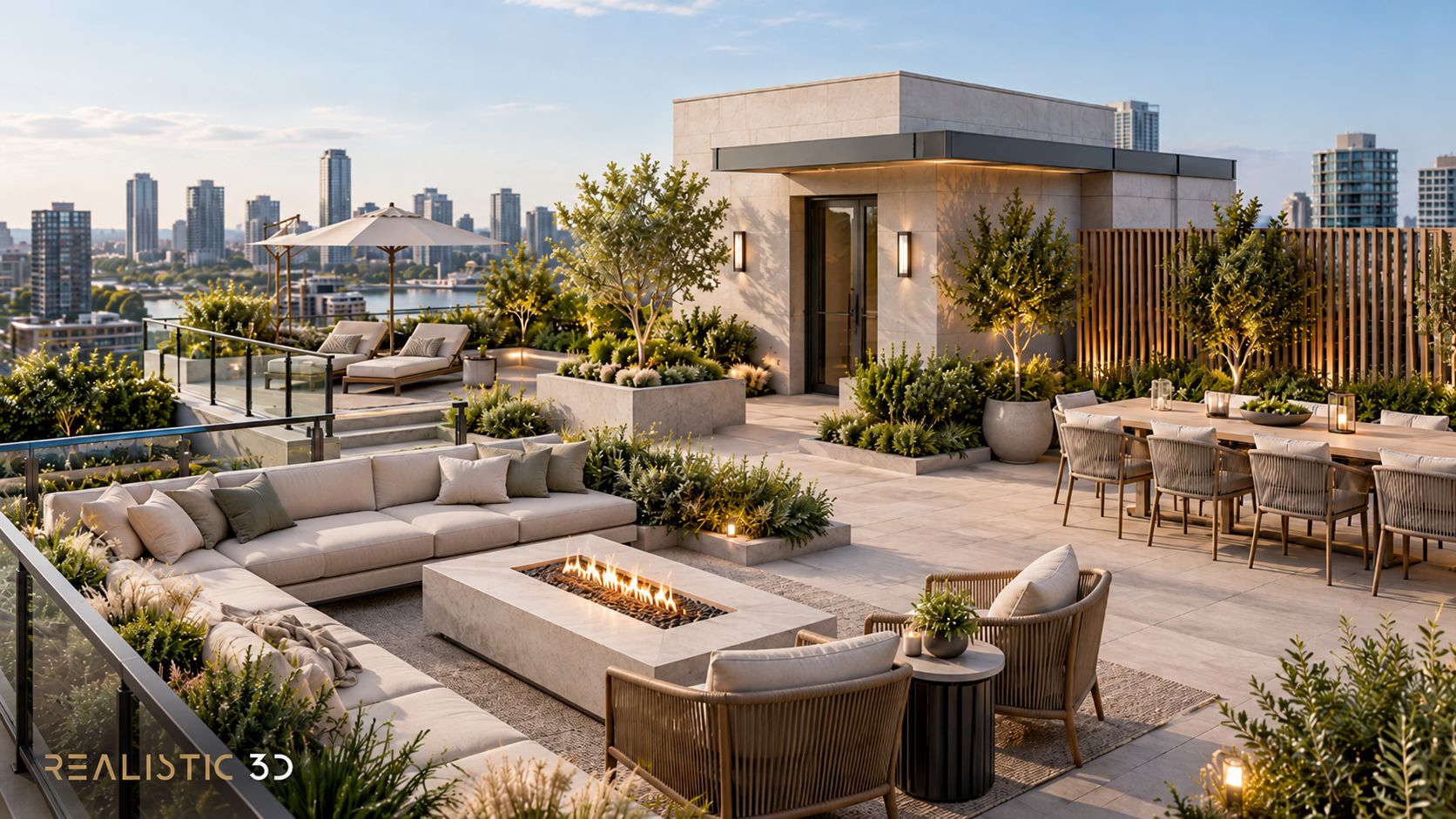
A developer can use architectural 3D rendering to show a proposed apartment facade, entry canopy, podium landscaping, rooftop terrace, balconies, glazing, materials, and streetscape months before those elements physically exist.
Photography has another strength. It can document the real site and surroundings without reconstructing them digitally.
For example, photographs can establish:
- The existing streetscape
- Nearby parks or waterfront
- Actual city or landscape views
- Surrounding retail and hospitality
- Existing transport connections
- Developer-completed projects
- Construction progress
- A completed display apartment
The two formats become much easier to brief once these responsibilities are separated.
Why Exterior Rendering Usually Leads the Pre-Launch Campaign
If the apartment development is still being designed, approved, excavated, or constructed, there may simply be no finished exterior to photograph.
Rendering removes that physical dependency.
Architectural information can be turned into proposed exterior views showing the building in a controlled visual environment. Depending on the project, the visualization team can work from floor plans, elevations, sections, CAD data, BIM models, landscape plans, material schedules, survey information, and site photography.
The technical workflow involves much more than exporting an architectural model. Official Autodesk rendering guidance identifies view creation, material appearances, lighting, plants and entourage, render settings, image generation, and refinement as separate components of producing a photorealistic building image.
For an apartment development, the visualization process may also need to resolve balconies, glazing, visible residential interiors, podium retail, landscape, rooftop equipment, neighbouring buildings, roads, cars, pedestrians, and distant context.
This makes CGI particularly suited to pre-launch campaigns where the central marketing question is:
What will the completed development look like?
What Photography Can Do Before the Building Is Finished
Real photography is not useless simply because the proposed apartment does not yet exist.
Its subject changes.
Instead of photographing the future building, the photographer can capture evidence around the development.
Real site context
Site photographs can show existing streets, vegetation, topography, surrounding properties, and local character.
These images can be used directly in campaign material or form the photographic base for a CGI photomontage.
Real outlook
For apartments sold partly on their views, actual photography can be valuable.
Photography from a drone, nearby accessible elevation, existing structure, or another properly controlled position may help document surrounding outlook where legally and technically appropriate.
The final marketing use needs careful review if the photograph does not originate from the exact proposed apartment position.
Location marketing
A rendering can reproduce a nearby beach, park, transport station, or dining precinct, but there is often little reason to rebuild an existing place digitally when high-quality photography can show it directly.
Developer track record
Images of completed developments provide a type of evidence that proposed CGI cannot provide. They show what the developer has physically delivered previously.
Construction progress
Once work begins, progress photography can gradually introduce real project evidence into a campaign that originally relied on CGI.
This is why pre-launch visual strategy should include photography even when the hero building images are rendered.
Rendering and Photography Should Answer Different Buyer Questions
Using both formats does not mean duplicating the same image twice.
Give each one a job.
| Buyer question | Stronger visual source |
| What will the proposed facade look like? | Exterior rendering |
| How will the completed entrance be designed? | Exterior rendering |
| What is actually beside the site now? | Photography |
| What will the landscaped podium look like? | Exterior rendering |
| What is the real surrounding neighbourhood like? | Photography |
| How will the building sit in its completed streetscape? | Rendering or controlled hybrid image |
| What can currently be seen from the site? | Photography |
| What has the developer delivered before? | Photography |
| How is construction progressing? | Photography |
| What will an unfinished future project phase look like? | Exterior rendering |
This division reduces repetition across the campaign.
It also prevents CGI from being asked to provide credibility where a real photograph would provide clearer evidence.
Do Buyers Prefer Renders or Real Photos?
There is no credible universal study showing that real photography always converts better than architectural CGI, or that CGI always converts better during pre-launch.
The context is too different.
Research does show that strong visual information matters during property search. Zillow’s 2025 US prospective-buyer research found that 26% of respondents ranked high-resolution photos as the most important listing feature, behind floor plans at 33%. Another 20% selected 3D or virtual tours. That study concerns general home shopping, not a controlled CGI-versus-photography comparison, so it should not be interpreted as proof that one pre-launch format has a higher conversion rate. Zillow’s 2025 prospective-buyer research
For developers, the practical conclusion is simpler.
Buyers need clear visual information.
Before an apartment is built, CGI can provide information that conventional completed-property photography cannot yet produce. Real photography becomes stronger where the thing being communicated already exists.
Exterior CGI Has One Major Advantage: Control
A renderer can control almost every visible component of an exterior scene.
That includes:
- Camera height
- Lens
- Time of day
- Sun position
- Weather
- Facade finish
- Landscape
- Trees
- Cars
- People
- Interior lights
- Balcony styling
- Ground-floor activity
- Background treatment
This control is valuable during pre-launch because marketing production does not need to wait for the right construction stage or weather.
It also creates responsibility.
The goal is not to use control to make the apartment appear materially different from the project being sold.
A developer may prefer mature planting visually. The landscape architect may specify young trees at completion. A CGI artist can technically create either.
That does not make both equally appropriate representations.
Photography Has One Major Advantage: It Documents Reality
Photography works within physical constraints, but those constraints are also part of its credibility.
A camera records the actual facade material, actual street, real tree canopy, real surrounding buildings, and real constructed dimensions that were visible at the time of the shoot.
For a completed apartment building, this is difficult for CGI to improve upon if the marketing objective is simply to show the finished property accurately.
Before completion, photography remains valuable wherever the real environment itself matters.
That might include a harbour outlook in Sydney, mountain context in Colorado, an established Melbourne streetscape, or an urban location in Austin.
The stronger strategy is usually to photograph what exists and render what does not.
A Hybrid Exterior Can Be More Useful Than Either Medium Alone
Apartment exterior visualization is sometimes built from both CGI and photography.
A developer may photograph the real site or wider landscape and insert the proposed 3D building into that image.
This can reduce the amount of distant environment that needs to be reconstructed and can give the viewer recognizable real-world context.
The method needs discipline.
Camera position, lens characteristics, horizon, perspective, scale, sunlight, shadows, atmospheric depth, and colour all need to work together. If the photography and CGI disagree, the building looks pasted into the scene.
A hybrid image can also create a false sense of certainty if the underlying photograph suggests that the rendered building is being shown from an exact verified position when it is not.
The purpose and required degree of verification should therefore be established before production.
Accuracy Matters Because Photorealism Can Make Proposals Look Final
Modern exterior rendering can produce highly convincing building imagery.
That improves communication, but it can also blur the viewer’s distinction between proposed and existing conditions.
Australian property marketing operates under consumer-protection requirements. The Australian Competition and Consumer Commission’s real-estate guidance states that real-estate agents must not mislead consumers about a property’s price or other property information and should provide truthful, complete information relevant to the property. State and territory rules may impose additional requirements.
In the United States, the Federal Trade Commission’s advertising guidance states that advertising claims must be truthful, cannot be deceptive or unfair, and must be evidence-based. State requirements can also apply.
These sources do not create a universal CGI rule for every development. Legal requirements depend on the jurisdiction and campaign.
For the visualization brief, however, they reinforce a sensible principle: do not present unsupported visual assumptions as confirmed property facts.
Which Parts of an Exterior Render Need the Most Control?
Apartment exteriors contain several areas where small visual choices can materially change perception.
Building proportions
Camera placement and field of view can alter the apparent height, depth, and scale of a development.
Very wide lenses can increase the apparent size of foreground spaces and compress the viewer’s understanding of the facade.
Glazing
Dark reflective glass can conceal interiors. Highly transparent glass can show spaces that have not actually been designed.
The treatment should follow the intended architecture and camera distance.
Balconies
Furniture, privacy screens, planting, and lighting can make balconies appear larger or more usable than they would if the objects are poorly scaled.
Landscape
Mature vegetation can change how much of the building is visible and how established the public realm appears.
Neighbouring buildings
Removing visually inconvenient context may create an inaccurate impression of openness, views, or urban density.
A detailed library of exterior rendering examples and guidance can help project teams distinguish hero facade, context, entrance, aerial, and dusk views before deciding which cameras belong in the launch campaign.
Real Photography Has Its Own Distortion Risks
Photography is real, but it is not automatically neutral.
A photographer still chooses:
- Lens
- Camera height
- Exposure
- Time of day
- Weather
- Composition
- Retouching
- Drone position
- What enters or leaves the frame
An extremely wide architectural photograph can exaggerate foreground space. Heavy sky replacement or object removal can materially change the impression of a location. Selective framing can hide surrounding conditions.
The difference is that photography begins with a real physical scene, while exterior CGI begins with a digital representation.
Both require editorial judgment.
For a pre-launch campaign, marketers should establish image-manipulation boundaries for real photographs as carefully as they establish accuracy rules for CGI.
Production Timing Is Very Different
Rendering can begin once the design information is sufficiently developed for the intended image.
The building does not need to exist.
Photography needs something physical to photograph.
That creates very different dependencies.
A CGI schedule may depend on:
- Architectural model readiness
- Facade approvals
- Landscape information
- Camera approval
- Material references
- Design revisions
- Rendering and post-production
A photography schedule may depend on:
- Site access
- Construction progress
- Landscaping completion
- Weather
- Sun position
- Staging
- Cleaning
- Traffic conditions
- Drone restrictions where relevant
Neither workflow is universally faster.
A renderer waiting for unresolved facade information can lose days. A photographer may complete a simple shoot quickly once the site is ready.
The better comparison is not production time in isolation. It is how early in the development program each medium can produce usable marketing information.
On that measure, CGI has the clear advantage for the proposed apartment exterior.
CAD and BIM Make Rendering Possible Earlier, but File Quality Matters
Apartment developments frequently have substantial digital design information before construction begins.
A Revit, Archicad, Rhino, or SketchUp model can reduce the need to reconstruct the entire building manually.
It may still need substantial preparation.
Documentation models can contain excess geometry, incomplete facade information, linked consultant files, placeholder objects, incorrect materials, or several design versions.
A structured CAD file preparation process can reduce uncertainty before exterior production starts.
The most useful handover normally identifies:
- Current architectural model
- Current elevations
- Landscape issue
- Material schedule
- Relevant sections
- Site plan
- Areas still under design
- Required cameras
- Intended marketing use
A digital model saves time only if the visualization team knows which information is current.
Rendering Is Easier to Revise Before Construction, but Changes Still Cost Time
CGI is often described as highly flexible.
That is true in a limited sense.
A renderer can change cladding, landscape, camera position, sky, furniture, or lighting without physically rebuilding the development.
But substantial late changes can still require considerable production work.
If the architect changes an entire podium facade after five cameras have been completed, each affected image may need remodelling, material changes, rerendering, and post-production.
Photography has the opposite constraint.
Once something has been built and photographed, changing the real facade generally means physical construction work or creating a digitally altered image that no longer represents the photographed condition exactly.
This makes CGI particularly valuable while design development is still active, provided the team distinguishes design-study revisions from approved marketing imagery.
Comparing Cost Without Inventing a Universal Winner
There is no useful universal rule that rendering is cheaper than photography or photography is cheaper than rendering.
The scopes are too different.
Exterior rendering costs can depend on:
- Model preparation
- Building complexity
- Context
- Landscaping
- Number of cameras
- Visible interiors
- Lighting versions
- Resolution
- Revisions
Property photography costs can depend on:
- Photographer and crew
- Travel
- Site access
- Drone work
- Number of locations
- Staging
- Retouching
- Usage requirements
- Reshoots
- Weather-related scheduling
CGI has one economic characteristic that can become useful for apartment campaigns: the approved 3D scene can support multiple views.
Once the project is built, materials and environment are established digitally, another camera may reuse much of that work.
Photography has its own reuse advantage. A well-planned completion shoot can generate a large number of authentic images in one visit.
The cost decision should therefore compare the complete campaign asset requirement, not one render against one photograph.
Use CGI to Control the Pre-Launch Visual System
Exterior rendering becomes more efficient when it is planned as part of the complete property campaign.
The same approved building model may support:
- Hero exterior images
- Entrance views
- Aerial CGI
- Dusk images
- Interior visualization
- Animation
- Sales-suite displays
- Campaign crops
A broader real estate 3D rendering workflow shows how different visual assets can carry different parts of the property story instead of expecting one hero image to explain the entire development.
This matters for apartment launches because buyers may move between a social ad, website, brochure, floor plan, sales appointment, and property portal.
Visual consistency across those touchpoints makes the project easier to recognize and understand.
Use Photography to Add Real Evidence Around the CGI
A strong pre-launch photography brief can be developed alongside the CGI brief.
Instead of waiting until completion, identify real subjects that already strengthen the campaign.
These might include:
Location: streets, public spaces, retail, parks, transport, coastline, skyline, or established neighbourhood features.
Views: properly documented existing outlook where relevant.
People and place: real local activity where releases and permissions permit its use.
Developer history: completed developments that demonstrate previous delivery.
Construction: progress at meaningful milestones.
Display environments: completed sales suites or show apartments when available.
The visual distinction should remain clear enough that viewers understand what exists and what is proposed.
When Should Photography Start Replacing CGI?
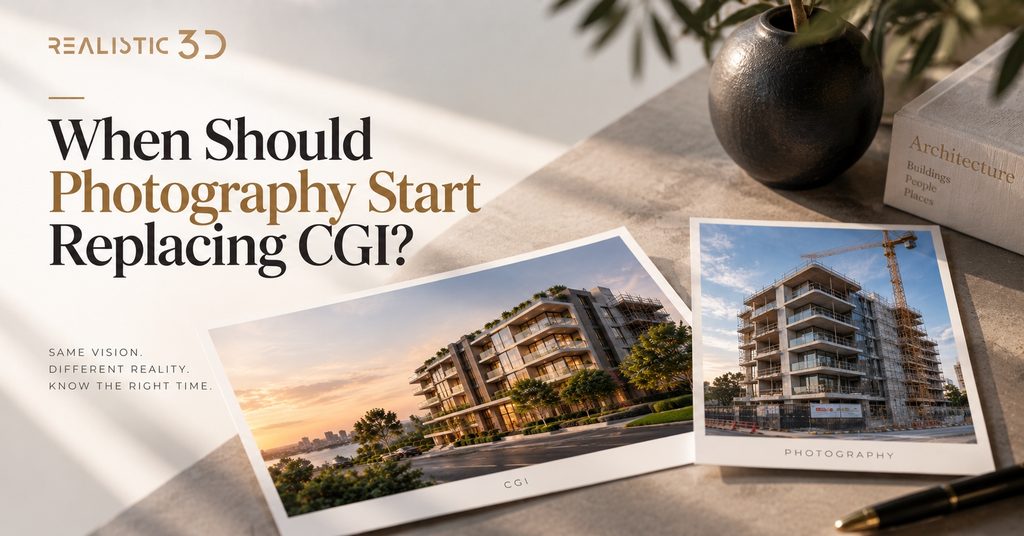
There is no single construction milestone.
Replacement should happen asset by asset.
If the completed entrance is ready, photographed, landscaped, and visually representative, there may be little reason to continue using an old entrance render.
If the tower exterior is complete but the rooftop landscape is unfinished, CGI may still be useful for that amenity.
If only the first project stage has been delivered, photography can document stage one while CGI explains future stages.
This creates a transition rather than a sudden switch.
A useful campaign asset register can classify visuals as:
- Proposed CGI
- Current site photography
- Construction photography
- Completed photography
- Superseded
- Approved for current use
That reduces the risk of an outdated render continuing to circulate after the built design has changed.
Compare Render and Finished Photography After Completion
One of the most useful quality-control exercises happens after the project is built.
Place the approved marketing render beside a photograph taken from a comparable position.
Review:
- Facade materials
- Window proportions
- Balcony geometry
- Landscaping
- Entrance design
- Roof elements
- Public realm
- Lighting
- Context
- Overall massing
The purpose is not to demand pixel-level similarity. Construction naturally develops and photography records a different moment.
The comparison can reveal where the visualization brief was accurate and where future campaigns need tighter design control.
A set of completed architectural visualization projects can also help developers assess whether a rendering provider maintains believable architecture across different project types rather than judging capability from a single dramatic image.
Common Mistakes in Render-vs-Photography Decisions
Waiting for photography when the campaign needs to launch now
If nothing meaningful exists to photograph, delaying pre-sales solely to obtain real building photography solves the wrong problem.
Using CGI to recreate things that already exist
A real park, coastline, established streetscape, or completed previous project may be communicated more credibly through good photography.
Treating rendering as unrestricted concept art
A property marketing render represents a proposed commercial product. Visual freedom needs to remain inside the boundaries of the documented design.
Treating every real photograph as objective evidence
Lens choice, retouching, framing, and camera position still influence perception.
Forgetting to update the campaign
An accurate render at design approval may become outdated after facade, landscape, or specification changes.
Switching to photography too early
An unfinished building site may be real, but it may communicate the final residential proposition poorly.
Switching too late
Continuing to rely on CGI after strong completed photography becomes available can waste an opportunity to show buyers the real built outcome.
A Practical Pre-Launch Visual Plan
Developers can structure the decision in six steps.
1. List what does not exist
Future facade, podium, landscape, rooftop facilities, and unfinished apartment areas normally point toward CGI.
2. List what already exists
Site, location, neighbourhood, surrounding amenities, real views, and completed developer projects normally point toward photography.
3. Identify the buyer questions
Decide which visual answers each question most accurately.
4. Mark every uncertain design element
Do not let unresolved design become invisible CGI assumptions.
5. Plan the transition
Decide which rendered assets should eventually be replaced with real photographs.
6. Review accuracy before publication
Architecture, landscape, context, views, labels, captions, and disclosures should be checked against the current campaign information.
This is a more useful decision system than asking which medium looks better.
Which Should Developers Choose?
For a true pre-launch apartment campaign, exterior rendering will usually be the primary method for showing the proposed building because the completed subject does not yet exist.
Real photography still deserves an active role.
Use it to establish the real site, actual surroundings, location, existing outlook, construction progress, and delivered track record. Then introduce completed property photography as parts of the development become ready to document accurately.
The strongest visual strategy is therefore often a controlled combination:
Render the future. Photograph the present. Replace proposed imagery with real evidence as the project becomes real.
That approach gives developers the flexibility needed to market before completion without asking CGI to prove things that photography can show more directly.
Is CGI better than photography for an apartment pre-launch?
For showing the proposed apartment building before completion, CGI usually has the practical advantage because the finished exterior cannot yet be photographed. Photography remains useful for the real site, location, existing surroundings, views, previous developments, and construction progress.
Can developers use real photography before construction begins?
Yes. Pre-construction photography can document the site, surrounding neighbourhood, amenities, landscape context, and other existing conditions. Those photographs can appear independently in marketing or support carefully prepared CGI composites where the proposed building is inserted into real context.
Should CGI be replaced once the apartment building is complete?
Often, yes, where completed photography communicates the same information more accurately. Replacement does not need to happen all at once. Some completed areas may be photographed while renders continue to represent unfinished stages, amenities, or future buildings within a larger development.
Is real photography automatically more trustworthy than rendering?
Photography records a physical condition, but composition, lens choice, retouching, timing, and selective framing still influence what viewers see. CGI requires another layer of interpretation because the building is proposed. Both formats should therefore be reviewed for accurate presentation.
Is exterior rendering cheaper than property photography?
There is no universal answer. Rendering costs depend on modelling, scene complexity, context, cameras, revisions, and output. Photography costs depend on the shoot, access, travel, equipment, staging, retouching, and possible reshoots. Compare the complete campaign requirement rather than one isolated image.
Can one CGI model produce several marketing images?
Yes. Once the building and surrounding scene have been prepared, additional cameras can reuse much of the same digital environment. New views still require composition, rendering, camera-specific detailing, and finishing, particularly where they reveal parts of the building or site that were not visible previously.
What should be photographed after construction starts?
Useful subjects include construction milestones, completed facades, landscape progress, display apartments, real views, finished entrances, amenities, and completed development stages. Photography should be introduced where the real built condition communicates the project more usefully than the earlier proposed image.
 Written byshawonWrites for the Realistic3D blog about 3D animation, exterior and commercial rendering, and virtual walkthroughs for property marketing.More from shawon