For a completed property, a well-produced video walkthrough often has the stronger route to an inspection because it shows the actual space a buyer can visit. For an off-plan or unfinished development, 3D animation usually has the advantage because it can present architecture, interiors, amenities and surrounding spaces that cannot yet be filmed.
That does not mean one medium has a universally higher conversion rate.
The better format depends on what exists at the time of marketing, what the prospective buyer needs to understand, where the content will appear, and what counts as a conversion. A social-media view, property enquiry, booked inspection, sales-centre appointment and reservation are very different outcomes.
That distinction matters for developers and real-estate marketers deciding where to put production budget.
First, What Counts as a Video Walkthrough?
The terminology can become confusing because architectural animation is sometimes called a 3D walkthrough.
For this comparison, the formats mean two different things.
3D animation is CGI generated from architectural information. The production team builds or imports a digital model, develops materials, lighting, furniture, site context and camera paths, then renders a sequence of frames that is edited into moving content.
Video walkthrough means footage recorded inside or around a physical property. It might be filmed on a smartphone, professional camera, gimbal or drone, then edited into a short property tour.
Both produce video files. Their source material is fundamentally different.
One shows a digital representation of what a property is intended to become. The other records what physically exists.
That single difference affects nearly every marketing decision that follows.
So, Which One Converts Better?
For completed residential property, filmed walkthrough video usually has the more direct relationship with inspection-focused conversion. For off-plan developments, 3D animation is usually the more useful conversion asset because there may be no finished property available to film.
The important question is not simply which video gets more views.
A better comparison is:
Which format gives this particular prospect enough relevant information and confidence to take the next commercial action?
Consider a completed apartment campaign. A buyer may want to know whether the kitchen feels cramped, how the living room connects to the balcony, what the natural light looks like and whether the listing photography reflects the property accurately. Real footage can answer those questions directly.
Now consider an apartment development that has foundations but no completed residences. Real footage of the construction site cannot communicate finished joinery, furniture scale, completed communal areas or the intended arrival experience. CGI can.
That is why conversion performance needs to be judged against the marketing problem rather than the file format.
3D Animation vs Video Walkthrough at a Glance
| Comparison factor | 3D animation | Filmed video walkthrough |
| Property needs to exist | No | Yes |
| Best suited to off-plan campaigns | Strong | Limited |
| Shows actual completed condition | No | Strong |
| Camera control | Very high | Limited by physical site |
| Lighting control | Very high | Dependent on filming and production |
| Architecture can be revised | Yes, before final rendering | Physical property cannot be digitally redesigned without additional post-production |
| Shows proposed finishes | Strong | Only if installed |
| Useful for planning future marketing | Strong | Requires sufficient construction progress |
| Production inputs | CAD, BIM, plans, schedules, references | Physical access, filming plan, property preparation |
| Main credibility source | Accuracy of digital representation | Visible evidence of actual property |
| Typical conversion role | Off-plan enquiry, project interest, presentation, pre-sales | Listing engagement, inspection, enquiry |
| Reuse across project campaign | High when planned carefully | High, but tied to recorded property condition |
Neither column should be interpreted as an automatic performance score. A technically impressive asset with the wrong content can still perform poorly.
Why Filmed Walkthroughs Can Convert Completed-Property Buyers
A completed property has one major marketing advantage: it can prove its own condition.
Real footage can show transitions between rooms, ceiling heights, windows, fitted finishes, circulation routes and the relationship between indoor and outdoor areas without reconstructing them digitally.
That reduces one form of buyer uncertainty.
The Australian market provides a useful real-world example. realestate.com.au reports that listings using its Property Walkthrough Reels receive 29% more views and 43% more inspection requests on average, based on REA internal data from January to October 2025. Those figures apply specifically to that platform and product, so they should not be interpreted as a universal conversion uplift for all real-estate video.
The same platform recommends a mobile-first 9:16 format for its walkthrough product and describes a room-by-room progression that follows the floor plan.
The principle behind that format is useful beyond one portal.
Buyers evaluating a completed home are often trying to answer concrete questions. They want to see how spaces connect, how much furniture a room can accommodate and whether the property deserves an in-person inspection.
A direct walkthrough can remove enough uncertainty for that next step.
Authenticity Is an Advantage, but Also a Constraint
Real footage carries visible evidence that CGI cannot provide.
It can also reveal problems.
Poor daylight, unfinished maintenance, clutter, tight spaces, distracting neighbouring properties or weak styling will all appear unless the filming strategy deals with them carefully.
That makes filmed video highly dependent on property readiness.
CGI has far greater control over presentation. That control is useful, but for a completed property it can also create an unnecessary gap between what the prospect sees in marketing and what the prospect encounters on inspection.
For established homes, credibility can be more commercially useful than visual perfection.
Why 3D Animation Has the Advantage Before Construction Is Finished
Off-plan marketing creates a different problem.
The marketing team may need to sell the qualities of an apartment, townhouse, office development or mixed-use project months or years before buyers can walk through the completed building.
A camera cannot record something that has not been constructed.
Architectural animation can work from design information instead.
Depending on the project, source material may include:
- Architectural drawings
- CAD files
- BIM models
- Floor plans
- Elevations
- Material schedules
- Interior design specifications
- Site information
- Furniture references
- Planting documentation
- Approved marketing finishes
The visualization team interprets those inputs into a moving representation of the proposed property.
This can communicate aspects of a project that separate still renders struggle to explain in isolation, such as the progression from street arrival to lobby, the relationship between open-plan living and a terrace, the sequence of communal amenities or the scale of a larger development.
The camera can also be designed around marketing priorities rather than physical access.
That makes 3D animation particularly relevant to apartment launches, masterplanned communities, build-to-sell developments, build-to-rent projects, commercial leasing campaigns and property repositioning.
Conversion Depends on the Action You Measure
A major mistake in this comparison is using “conversion” as if it describes one metric.
It does not.
For one campaign, conversion might mean a completed enquiry form. For another, it might mean an inspection booking. A developer selling off-plan apartments may measure qualified leads, sales-suite appointments, brochure downloads, database registrations, reservations or deposits.
A video can perform well against one metric and poorly against another.
Consider four possible results:
A short CGI animation receives strong social reach but few qualified enquiries.
A filmed walkthrough receives fewer views but generates more inspection requests.
A longer development animation performs poorly on social media but helps sales representatives explain a complex masterplan during appointments.
A 15-second animation cutdown generates inexpensive landing-page traffic while a longer version assists prospects further into the decision process.
Which one converted better?
There is no useful answer until the campaign owner defines the conversion event.
Measure Progression, Not Just Video Views
Useful measurements may include:
- Video completion rate
- Click-through rate
- Property-page engagement
- Floor-plan views
- Brochure downloads
- Enquiry submissions
- Calls
- Inspection bookings
- Sales appointments
- Qualified lead rate
- Cost per qualified enquiry
- Reservation or application rate
Views and likes can be useful distribution signals, but they should not automatically be treated as evidence of property demand.
For development marketing, CRM data becomes particularly valuable because it can connect the content source to lead quality rather than stopping at advertising-platform engagement.
Buyer Information Needs Matter More Than Production Style
The strongest property video answers questions that are relevant to the next decision.
A cinematic animation that spends 20 seconds on clouds, trees and slow aerial movements may look polished while giving a buyer little information about the apartment.
Likewise, a filmed walkthrough that rushes through every room can technically document the property while making spatial relationships difficult to follow.
Both formats need editorial discipline.
Ask what the prospect still does not understand.
For a residential development, that may include:
- How large do the living areas feel?
- How does the kitchen relate to dining and outdoor space?
- Where are bedrooms positioned?
- What is the building arrival sequence?
- What amenities are available?
- What outlook is being represented?
- What finishes are proposed?
- How do different unit types vary?
For an existing listing, questions may be more immediate:
- What condition is the property actually in?
- How do the photographs connect spatially?
- Is the outdoor area directly accessible from the main living zone?
- Which spaces deserve an inspection?
- Does the property appear consistent with the listing description?
Conversion improves when the content resolves useful uncertainty.
Architectural Accuracy Can Affect 3D Animation Performance
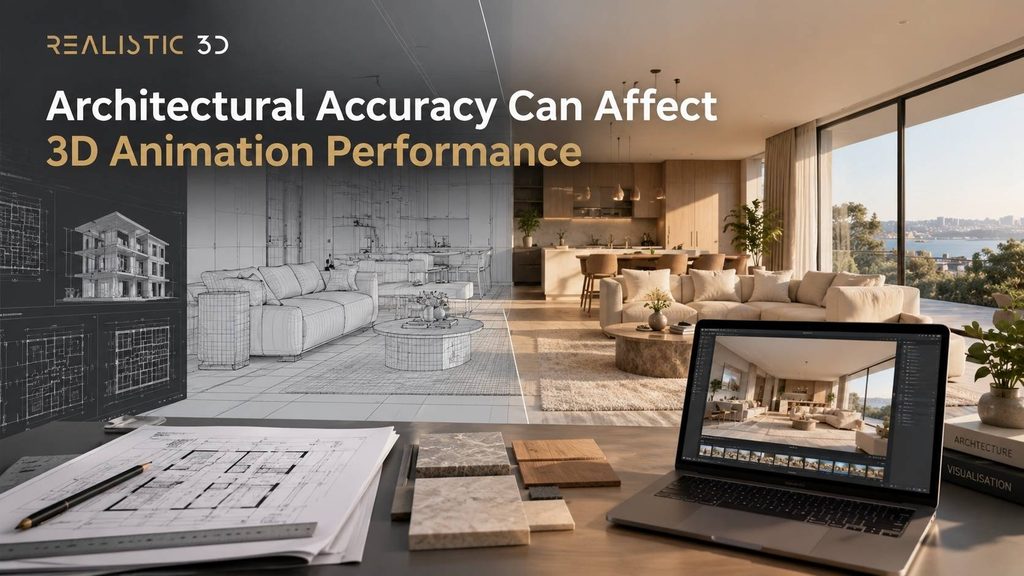
CGI introduces a responsibility that filmed video does not have to the same degree: the visual representation must remain consistent with the supplied design information.
A polished animation with incorrect window proportions, altered materials, unrealistic views or excessive spatial distortion can create the wrong expectation.
Accuracy begins with the brief.
A production team may need to establish which information is approved, which elements remain provisional and which visual decisions are being made for presentation purposes.
Changes late in production can become expensive because animation is made from sequences of rendered frames rather than isolated images.
If the kitchen design changes after a long interior shot has been rendered, updating the animation can require revising the 3D scene and producing affected frames again.
That makes design sign-off particularly important.
Camera Design Changes How Space Is Perceived
Camera movement deserves similar attention.
A very wide field of view can make rooms appear larger than expected. Fast movement can make layouts difficult to understand. Excessively low or high cameras may create attractive compositions while feeling detached from normal human eye level.
For property marketing, camera direction should balance visual quality with spatial honesty.
The same principle applies to real footage. Wide lenses, aggressive stabilization, rapid edits and selective framing can alter how the viewer perceives the property.
The technical method differs, but responsible presentation matters in both formats.
Production Quality Can Affect Conversion Before the Format Does
Choosing CGI instead of filmed video will not rescue weak execution.
Several production decisions can have a larger effect on usability than the medium itself.
For 3D Animation
Pay particular attention to model accuracy, material definition, lighting, camera pacing, furniture scale, vegetation, human figures where appropriate, reflections and post-production.
The visual treatment should match the property category.
A high-end residential development may need carefully controlled art direction. A large industrial or commercial development may benefit more from clarity around access, scale, tenancy areas and site relationships.
For Filmed Walkthroughs
Preparation becomes physical rather than digital.
The property should be clean, styled appropriately and filmed when available light supports the rooms being presented. Camera movement should remain stable, room transitions should be understandable and the sequence should have an obvious spatial logic.
Good audio, captions and restrained editing may also matter depending on the distribution channel.
Neither production method should add complexity simply to demonstrate technical capability.
The property remains the subject.
Where the Content Will Appear Changes the Decision
The same master video should not automatically be distributed unchanged across every channel.
Property Portals
For completed listings, filmed walkthrough content has an obvious advantage because viewers are already evaluating a specific available property.
Australia provides a particularly clear example. realestate.com.au has built vertical Property Walkthrough Reels directly into its listing experience and recommends videos of 90 seconds or less for that product.
US buyer research also suggests that video should be viewed as one part of the listing information package rather than a replacement for other assets. Zillow’s 2025 prospective-buyer study found floor plans were selected as the most important listing feature by 33% of respondents, high-resolution photos by 26%, 3D or virtual tours by 20%, and video by 4%. These categories are not the same as CGI animation versus filmed walkthrough, but the findings reinforce the importance of spatial information alongside moving content.
Social Advertising
Social channels create a different requirement.
A viewer may have little prior knowledge of the development and may not be actively searching for that property.
Short CGI sequences can work well when a project does not exist yet because the marketer can create visually controlled material before construction finishes.
Completed properties can use filmed video equally well, particularly when distinctive architecture, views, interiors or amenities are visible immediately.
The opening seconds matter more than lengthy cinematic introductions.
Development Landing Pages
A landing page can use multiple formats because the visitor has chosen to learn more.
A short hero sequence may establish the visual identity. Still architectural renders can show important spaces. Floor plans can explain geometry. A longer animation may communicate the project sequence.
Here, one asset does not need to do every job.
Sales Suites and Investor Presentations
For larger proposed developments, architectural animation can be particularly useful in presentations because the presenter controls the discussion around an unbuilt design.
Masterplan movement, building approaches, communal facilities and interior transitions can be shown in an intentional sequence.
The purpose may be stakeholder comprehension rather than an immediate online form submission.
That is still commercially useful.
Australian and US Campaigns Should Consider Distribution Differences
The fundamental visual principles are similar in both markets, but distribution practices differ.
In Australia, the property portal environment gives marketers specific native options for short filmed walkthrough content. Current realestate.com.au material reports 43% more inspection requests for listings using its Property Walkthrough Reels, based on its own internal platform analysis. Again, that is a platform-specific result rather than a universal benchmark.
In the United States, brokerage sites, MLS distribution, developer websites, social platforms and property portals create a more fragmented publishing environment. NAR’s 2025 technology survey reported that 52% of surveyed REALTORS® used drone photography or video, indicating that moving property imagery is already familiar within agent marketing workflows.
The practical implication is simple: choose the production format with distribution specifications already in mind.
Aspect ratio, duration, captions, hosting, file size, thumbnail selection and reuse requirements should be discussed before production rather than after the final film has been delivered.
When a Hybrid CGI and Video Approach Makes Sense
There are situations where the distinction between CGI and filmed footage does not need to become an either-or decision.
Consider a development with a completed location and sales display but unfinished residences.
Real footage can establish the neighbourhood, nearby destinations, genuine views, completed streetscape or display suite.
CGI can present the future building and interiors.
The two can then be edited into one campaign system, provided the transitions are clear and proposed imagery is not presented in a misleading way.
Hybrid production can also work for:
- Major refurbishments
- Office repositioning
- Hotel redevelopment
- Retail projects
- Residential extensions
- Masterplanned developments under staged construction
- Projects with completed amenities but unfinished residences
This approach uses physical footage where reality provides useful proof and CGI where future design needs to be communicated.
How to Choose Between 3D Animation and Video Walkthroughs
A practical decision can be made with six questions.
1. Does the finished property exist?
If no, CGI is likely to carry much more of the visual communication.
If yes, consider whether recreating the completed property digitally adds enough value to justify doing so.
2. What does the prospect need to understand?
If the problem is understanding a future design, CGI has an advantage.
If the problem is verifying the condition and flow of an existing property, real footage may answer the question more directly.
3. What action should happen after viewing?
Identify the actual conversion event.
An inspection request requires different information from an investor presentation or off-plan registration.
4. Where will the content be distributed?
Portal, social feed, website, sales presentation and display-screen content have different viewing behaviour and technical constraints.
Choose the format with those destinations established.
5. How stable is the design?
For CGI, unresolved architecture or interiors can produce avoidable revision cycles.
If important design decisions remain fluid, consider which shots should be delayed and which assets can safely proceed.
6. What other marketing assets are required?
A CGI production may also generate still renders, short animation edits and other campaign imagery from the same developed scenes.
A property filming day can produce landscape video, vertical reels, detail shots, agent-led content and social cutdowns.
Evaluate the asset package rather than comparing only two finished videos.
Which Format Should a Property Marketing Team Choose?
Choose 3D animation when the marketing task depends on showing architecture that cannot yet be filmed, controlling the visual presentation of a proposed design, explaining a larger development or supporting pre-sales before completion.
Choose a filmed video walkthrough when the completed property itself provides the most useful evidence and the desired action is closely connected to viewing or inspecting that real property.
Choose both when the campaign spans different stages of construction or when real-world context and proposed architecture each answer different buyer questions.
The format alone does not create conversion.
The stronger asset is the one that presents the right property information, to the right audience, at the right point in the decision process, then gives that audience a clear next action.
For real-estate marketers deciding where to invest, that is a more reliable test than asking which type of video looks more impressive.
Does 3D animation convert better than a real estate video walkthrough?
Neither format has a universal conversion advantage. 3D animation is generally more useful for off-plan and unfinished developments because it can show the proposed finished property. Filmed walkthroughs can have a more direct role for completed listings where buyers need to evaluate the actual property before requesting an inspection or making an enquiry.
Is 3D animation only useful for properties that have not been built?
No. CGI animation can also be useful for refurbishments, proposed interior changes, commercial repositioning, future construction stages and presentations that require camera movements or design information that conventional filming cannot provide. For a completely finished property, however, marketers should consider whether real footage can communicate the required information more directly.
Can a video walkthrough market an off-plan development?
Real video can support an off-plan campaign, but it cannot directly record an unfinished interior as if it were complete. Footage may show the location, construction progress, display suite, existing views or surrounding context. CGI can then communicate the parts of the development that have not yet been constructed.
What should marketers measure as a conversion?
The measurement should reflect the campaign objective. Depending on the project, useful conversions include enquiries, inspection bookings, brochure downloads, sales-suite appointments, qualified leads, reservations or applications. Video views and completion rates can help diagnose engagement, but they should not automatically be treated as sales conversions.
Which format is better for social-media property advertising?
Both can work. CGI animation is useful when an unbuilt project needs visually controlled campaign material. Filmed video works particularly well when the existing property’s appearance, location or interiors provide strong visual content. Shorter edits designed specifically for vertical or mobile viewing will usually be more practical than simply republishing a long master film.
Do buyers prefer video or 3D property content?
The answer depends on what is meant by 3D content. Zillow’s 2025 US prospective-buyer research ranked 3D or virtual tours considerably higher than ordinary video as the single most important listing feature, although interactive tours are different from CGI architectural animation. Buyer preference therefore should not be used as proof that architectural animation automatically outperforms filmed video.
Should Australian and US property campaigns use the same video strategy?
The underlying decision criteria are similar, but distribution should be planned for each market and platform. Australian portals such as realestate.com.au provide specific native walkthrough-video formats. US campaigns may distribute content across MLS-connected services, brokerage websites, portals, development websites and social channels. Production specifications should reflect the intended destinations.
 Written byshawonWrites for the Realistic3D blog about 3D animation, exterior and commercial rendering, and virtual walkthroughs for property marketing.More from shawon